

Key Features:
- Multi-Market Support: Single API endpoint automatically handles both German and Dutch market requirements, with built-in validation and format creation for each TSO’s specific protocols.
- Intelligent Version Management: Full version control system with automatic tracking of schedule modifications, allowing retrieval of historical versions and complete change history for regulatory compliance.
- Real-Time Status Tracking: Monitor schedule acceptance status in real-time with detailed feedback from TSOs, including preliminary, final, and settled acceptance levels, according to each TSO’s ruleset.
- Time Series Flexibility: Support for multiple aggregation types and resolutions (15-minute, hourly, daily intervals) with automatic handling of timezone conversions and daylight saving time transitions.
- Enterprise-Ready Security: Engrate APIs use industry-standard OAuth 2.0 for secure authentication and authorization and comprehensive audit logging.
Developer & Operations Tools
Beyond the API, Engrate provides a comprehensive suite of tools to streamline development and operations. Our debugging tools allow you to trace and troubleshoot schedule submissions in real-time, identifying any validation issues or TSO responses before they impact production. The Schedule Management Dashboard gives you a visual overview of all your schedules across both markets, with filtering, search, and detailed status tracking capabilities. Additionally, our Audit Tools provide complete transparency with searchable logs of all API interactions, schedule modifications, and system events, ensuring you maintain full compliance and can quickly investigate any issues. Full access to the raw schedule data makes the tool complete. Schedule tool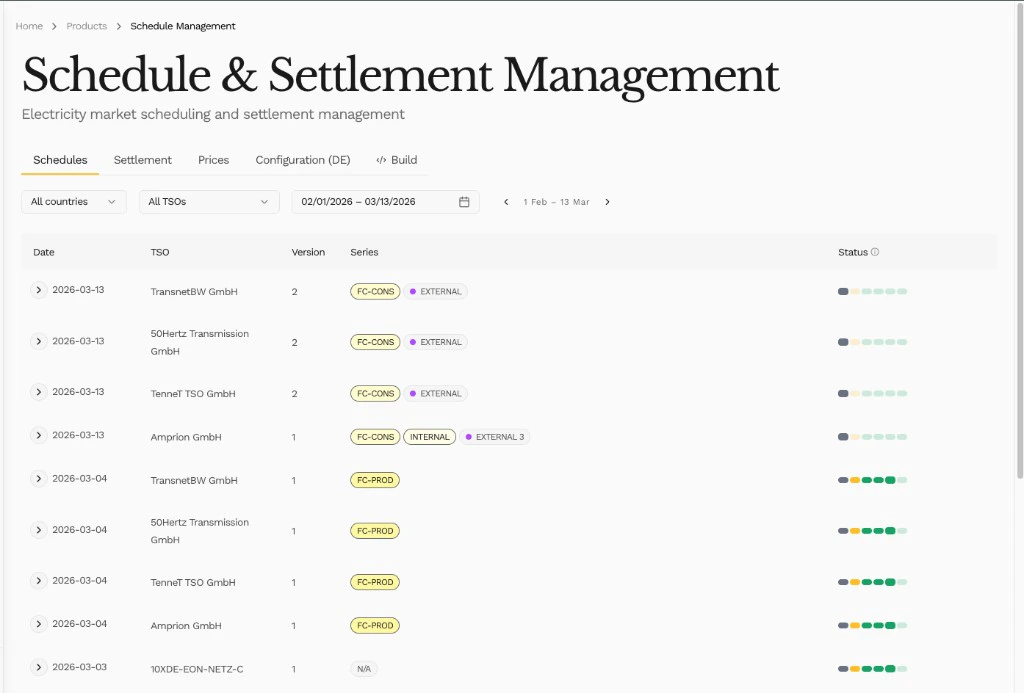
Overview of status for each schedule
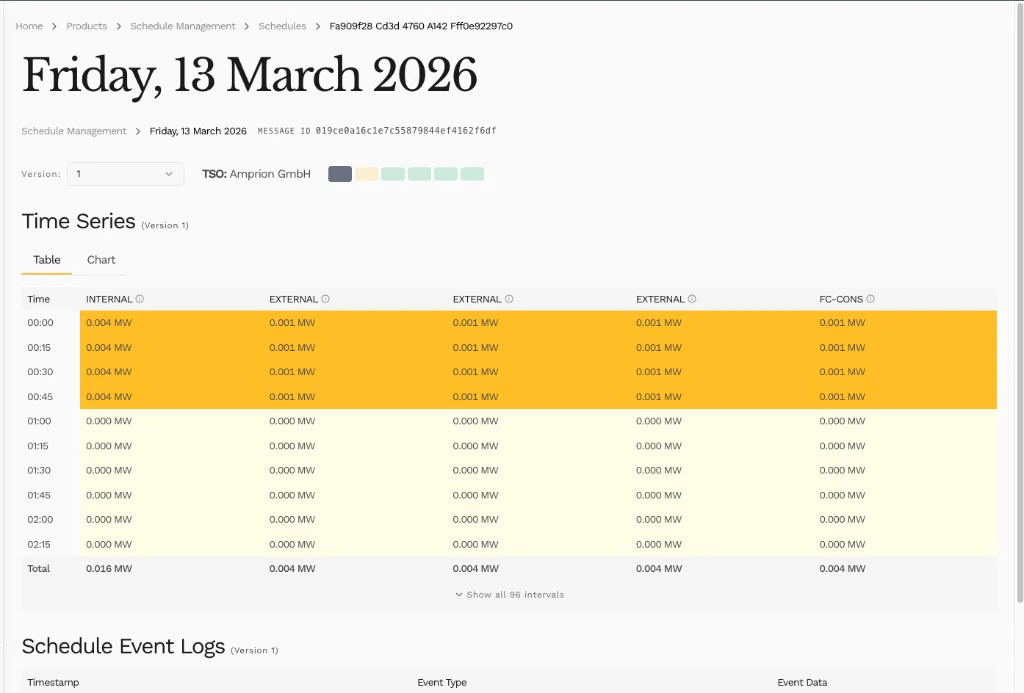
Detailed view of a specific schedule and active version
Expanding CoverageWe’re continuously adding support for more countries and TSOs across Europe to provide comprehensive coverage for the energy market. Our roadmap is driven by customer needs, so please reach out to let us know which markets and TSO integrations would be valuable for your business - we prioritize development based on customer demand.
Germany (DE) scheduling
Use this section as the DE-specific companion to the API reference endpointPOST /schedule-management/v1/schedules.
Scope
This applies to schedule submissions for the German market (market=DE or market=germany), including:
- Day-ahead and intraday submissions
- Internal, external, and foreign schedule series
- Gate closure checks and correction windows
Core identifiers
For DE payloads, ensure identifiers are market-valid:- TSO identifiers:
50HERTZ_DE_TSO,DE-AMPRION-TSO,TTG_DE,DE-TRANSNETBWTSO - Receiver ID: EIC X code for the target TSO
- Area IDs (
in_area,out_area): EIC Y codes - Party IDs (
in_party,out_party): EIC X codes - Market agreement ID: required for
externalandforeignseries
Gate closure overview (DE)
- Day-ahead: open until D-1 14:30 CET
- DA matching window (D-1 14:30-16:00 CET): internal accepted, external/foreign corrections only
- Intraday: D-1 16:00 CET until GCT (15-minute lead time for external/foreign)
test=true only for development/testing scenarios where gate-closure checks should be skipped.
Example request (DE)
Common DE validation pitfalls
series.datacount does not match expected DST-aware interval countmarket_agreement_idomitted forexternal/foreign- TSO and EIC identifiers mixed across different control areas
- Submissions sent after gate closure without
test=true
Netherlands (NL) scheduling
Use this section as the NL-specific companion to the API reference endpointPOST /schedule-management/v1/schedules.
Scope
This applies to schedule submissions for the Dutch market (market=NL or market=netherlands), including:
- Day-ahead submissions to TenneT NL
- CIM XML generation and AS4 delivery flow
- Zero-schedule and cancellation patterns
Core identifiers
For NL payloads, ensure identifiers are market-valid:- TSO identifier:
TENNET_TSO - Receiver ID: TenneT NL EAN-13 code (for example
8716867111163) - Area IDs (
in_area,out_area): typically10YNL----------L - Party IDs (
in_party,out_party): EIC X organization codes
Gate closure overview (NL)
- Day-ahead window: D-2 10:00 CET to D-1 15:00 CET
Example request (NL)
Common NL validation pitfalls
- Mixing DE-style TSO values with
market=NL - Invalid receiver format (EAN-13 expected for TenneT NL)
- Incorrect timestamp interpretation around delivery date boundaries
- Assuming DE gate windows apply to NL workflows
API reference
Explore how to interact with the Schedule Management API